Long-distance highway driving in India is usually discussed at two extremes. On one end, you have glossy road-trip narratives built around new cars, wide highways, and ideal conditions. On the other, you have anxious forum posts questioning whether a particular car is “capable” of doing a long drive at all. Real-world ownership lives somewhere in between, as I discovered in this Mumbai to Hyderabad road trip.
Introduction: Why this drive deserved to be written about
This Mumbai to Hyderabad road trip was done in a 7.5-year-old Tata Tigor during peak holiday season, with real traffic, real fatigue, and no attempt to optimise conditions, inconsistent road discipline, and no attempt to optimise for Instagram-friendly outcomes.
It was not planned as a statement drive. It happened because flying suddenly stopped making economic sense, return dates were unclear, and driving offered control, flexibility, and predictability that air travel did not.
What followed was not a flawless highway experience, but a revealing one.
This article is not about the destination. It is about what actually happens when you ask an ageing, well-maintained petrol car to cover serious distances on Indian highways, and what matters far more than horsepower, ground clearance, or badge value when you do so.
1. Context, the car, and why this drive mattered
The trigger for this drive was cost.
A one-way Christmas flight from Mumbai to Hyderabad was quoting around to ₹20,000 per person, for a route that usually costs around ₹4,500. With two people travelling, that meant nearly ₹40,000 one way, and with unclear return dates, booking flights made little sense.
At that price point, driving stopped being a romantic choice and became a rational one.
The car for this journey was my Tata Tigor AMT, purchased new in 2018 and still largely stock. The intent was not to prove endurance or heroics, but to answer a simpler question:
Can an ageing compact sedan still handle a serious intercity drive without turning it into a stressful affair?
Facts for the Nerd in you
Here is a full set of information about the car, fuel and distance for those who are interested. Click here to show/hide.
| Car Profile | |
|---|---|
| Car | Tata Tigor AMT (Petrol) |
| Year of Purchase | 2018 |
| Age at Time of Trip | Approximately 7.5 years |
| Engine | 1.2L Naturally Aspirated Petrol |
| Transmission | AMT |
| State of Tune | Stock (no performance modifications) |
| Driving Modes Used | ~95% Sports mode, City mode only in bumper-to-bumper traffic |
| Odometer & Usage | |
| Odometer Before Trip | 115,314 kms |
| Odometer After Trip | 116,791 kms |
| Total Distance Covered (Round Trip) | 1,477 kms |
| Pre-Trip Preparation | |
| Tyre Valves | Rubber valves replaced with metal valves (puncture-fraud avoidance) |
| Wheel Alignment & Tyre Rotation | Completed before the trip |
| Tyres | Vredestein 15-inch (installed ~40,000 km prior) |
| Suspension | Replaced earlier in 2025 |
| Trip Overview | |
| Route | Mumbai ⇄ Hyderabad |
| Distance (One Way) | Approximately 710–720 km |
| Outbound Start Time | 3:00 pm (Christmas Day) |
| Outbound Duration | 12 hours 39 minutes (including breaks) |
| Return Start Time | 2:00 pm (3rd January 2026) |
| Return Duration | Approximately 14 hours 20 minutes |
| Fuel & Efficiency | |
| Fuel Types Used | Shell V-Power, Shell Regular, Jio BP Petrol, HP (fallback only) |
| Fuel Strategy | Prioritised fuel quality consistency over price |
| Mileage Calculation Method | Full-tank to full-tank (MID not relied upon) |
| Observed Real-World Efficiency | 13.8 Kmpl, Mid-teens kmpl under mixed traffic and long-distance conditions was showing between 15.5 to 19.9 at various stages |
| Road & Driving Conditions | |
| Maharashtra | Poor lane discipline, diversions, trucks and buses occupying right-most lanes |
| Karnataka & Andhra Pradesh | Smoother surfaces, better lane behaviour, easier sustained cruising |
2. The car, age, condition, and realistic expectations
This was not a casual “let’s see how it goes” drive. Some deliberate pre-trip actions were taken to reduce avoidable risks.
Before the trip:
Rubber tyre air refill valves were replaced with metal valves, primarily to avoid puncture-related fraud or valve damage at roadside tyre shops
Wheel alignment and tyre rotation were completed
Suspension had already been replaced earlier in 2025
Tyres were Vredestein 15-inch, installed roughly 40,000 km prior to the trip
During the drive:
Approximately 95 percent of the drive was done in Sports mode
City mode was used only during bumper-to-bumper traffic
On highways, Sports mode reduces AMT indecision, keeps the engine better engaged, and makes throttle response more predictable, especially during overtakes. Over long distances, this directly reduces mental fatigue.
Expectations were realistic. A 7.5-year-old compact sedan is not meant to feel effortless. The benchmark here was stability, predictability, and the absence of anxiety.
3. Route, timing, and why timing mattered more than expected for your Mumbai to Hyderabad road trip
The outbound leg started at 3:00 pm on Christmas Day, after my spouse returned from church.
This immediately proved to be non-ideal.
Traffic around Lonavala and Pune was severe, with holiday congestion delaying progress by 2 to 3 hours early in the drive. Even after crossing Pune city limits, smaller vehicles like bikes and auto-rickshaws kept interrupting flow, preventing consistent cruising speeds.
The return leg began at 2:00 pm, with an expectation that traffic would thin out later in the night. That assumption only partially held.
Despite late-night hours:
Pune still had noticeable traffic close to midnight
Multiple road diversions disrupted flow
Truck density increased significantly post-midnight
The idea that highways automatically clear out at night does not hold true on this route, especially around major urban and logistics corridors.
4. Drive hours, breaks, food, and fatigue management
Break planning was consistent on both legs, roughly every 90 to 120 minutes, but execution differed.
On the outbound leg:
Breaks were shorter and functional
Food was a mix of café stops and home-cooked meals eaten inside the car
The focus was on maintaining momentum despite early delays
Key early stops included:
The food court near Khalapur Toll Plaza, with coffee and snacks
Multiple fuel stops for bio breaks
A tea stop just before Indapur, after which traffic thinned considerably and pace improved
On the return leg, breaks were longer and more relaxed, which increased total drive time but improved physical comfort.
A special mention is due to the Fairfield Marriott team, who thoughtfully packed cut fruits and pastries for the journey. Combined with home-packed food from a friend’s family, this removed the need to hunt for food late at night and materially improved the return-drive experience. These small operational gestures make a disproportionate difference on long highway runs.
One consistent frustration on both legs was coffee availability. Jio BP stations did not have Wild Bean cafés, and reliable options were scarce late at night. Shell fuel stations turned out to be the most dependable for a proper hot cup of coffee.
5. Time on road, distance, and what the numbers actually say about your trip from Mumbai to Hyderabad
The outbound Mumbai to Hyderabad leg took 12 hours and 39 minutes, including all breaks, over a distance of approximately 710–720 km.
The return leg took longer:
Start time: 2:00 pm
Arrival time: 4:20 am
Total duration: just over 14 hours
The reasons were cumulative:
Longer, more relaxed breaks
Persistent traffic around Pune even late at night
Road diversions
Heavy truck movement across all lanes
A particularly frustrating aspect was lane discipline. Trucks, tempos, and buses frequently occupied the right-most lane at around 60 kmph, including on the expressway. This forced constant speed modulation and increased mental fatigue, despite otherwise decent road surfaces.
For good measure, I also purchased the Annual toll pass by NHAI that saves on the cost for the entire years future drives.
6. Fuel efficiency, fuel choice, and real-world behaviour
Fuel choice for this drive was intentional.
Across both legs, I used a mix of:
Shell V-Power
Shell regular petrol
Jio BP petrol
HP pumps, only when Shell or Jio BP were unavailable
This was less about price and more about fuel quality consistency. From long-term ownership experience, Shell and Jio BP have delivered more predictable engine behaviour than legacy PSU pumps. On a naturally aspirated petrol engine paired with an AMT, that predictability matters.
Fuel efficiency was calculated using full-tank to full-tank logic, not MID readings.
Why this matters:
MID typically shows a deviation of ~1.5 to 2.5 kmpl
Long idling and traffic distort averages
Tank-to-tank remains the most reliable method
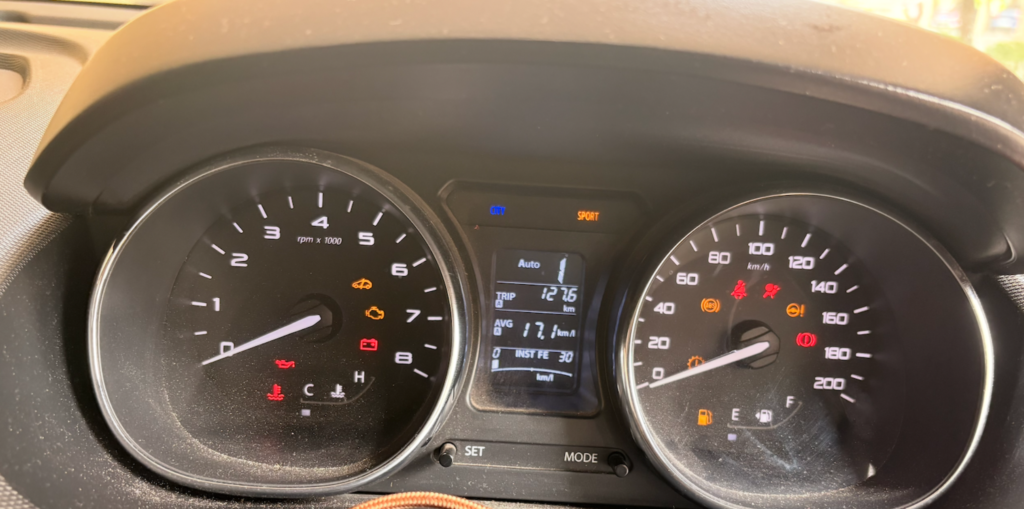
Despite traffic delays, idling, and long hours, the car delivered 13.8 Kmpl, Mid-teens kmpl under mixed traffic and long-distance conditions was showing between 15.5 to 19.9 at various stages
The more important takeaway was not the number itself, but this:
there was zero range anxiety, no unexpected drop-offs, and no change in engine behaviour even after long continuous stints.
For reference, here’s a snapshot of the MID during the drive. While I do not rely on MID figures alone, it helps establish directional consistency.
7. Road quality, stress, and comfort as you drive to Hyderabad from Mumbai
Road quality played a decisive role in how this drive felt.
Within Maharashtra, inconsistent surfaces, diversions, and poor lane discipline acted as constant stress multipliers. Even when the car was capable, the environment did not allow it to settle into a calm cruising rhythm.
The moment we crossed into Karnataka and later Andhra Pradesh, the contrast was immediate:
Smoother surfaces
Minimal undulations
Predictable lane behaviour
Despite being the same National Highway on paper, execution quality was dramatically better, in some sections even better than parts of the Mumbai–Pune Expressway.
This directly translated into:
Sustained cruising at 100–120 kmph
Lower cabin stress
Reduced mental fatigue
The lesson was clear: road quality and discipline influence comfort far more than vehicle segment or age.
Conclusion: What this drive really proved?
This drive did not prove that everyone should start doing 700+ km highway runs in compact sedans.
What it did prove is more uncomfortable.
A well-maintained, 7.5-year-old petrol car is not the weakest link on Indian highways. More often than not, the weakest links are road quality, traffic discipline, and governance.
The car did its job.
It cruised when roads allowed it
It delivered predictable fuel behaviour
It introduced no mechanical anxiety
It handled long hours without falling apart
The stress came from elsewhere.
From broken surfaces that have no business existing on a National Highway.
Trucks occupying the right-most lanes at 60 kmph add to the stress.
Diversions appear without warning and linger indefinitely.
And the stark contrast in execution quality becomes obvious the moment you cross state borders.
This is not a car problem. This is a governance problem.
We are quick to recommend bigger engines and bigger cars for highway comfort. Far less attention is paid to the fact that consistent roads and enforcement reduce fatigue more than any vehicle upgrade ever will.
If this drive proved one thing, it is this:
You don’t always need a new car to do long drives.
You do need better roads, better discipline, and better accountability.
List of pitstops with links where possible.
Leave a Reply to Why I Enjoy Long-Distance Driving? | Indianomics Cancel reply